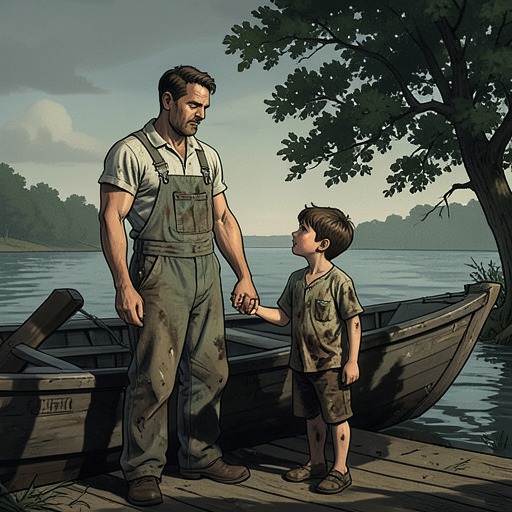
Tate Walker and Scupper: Father and Son
Where the Crawdads SingTate Walker and Scupper’s relationship is built less through declarations than through repeated acts of work and attention: unloading shrimp, repairing The Cherry Pie, sharing meals, and talking about school. In a household marked by the absence of Tate’s mother and sister, Scupper’s practical companionship also carries a quieter lesson about grief and what it means to be a man.
Family and Household
Scupper is Tate’s father, a large, red-haired man whom people in the village know by that name. Their family history reaches back to Scupper’s great-great-grandfather, a Scottish emigrant shipwrecked off the North Carolina coast in the 1760s. The sole survivor, he swam ashore on the Outer Banks, found a wife, and fathered thirteen children. Although many of the Walkers could trace their roots to him, Scupper and Tate mostly kept to themselves and did not often join the relatives’ Sunday picnics as they once had, when Tate’s mother and sister were still there.
The mother and sister remain present in the household through memory rather than action. A picture beside the kitchen window shows them wearing baseball caps; Tate remembers that Carianne loved her Atlanta Crackers cap and wore it everywhere. While preparing dinner, he imagines how the kitchen would have been different if they were there: his mother basting chicken and Carianne cutting biscuits. The scene places an unspoken absence inside an ordinary domestic routine, without explaining more about what happened to them.
The home itself is a two-story house with weathered cedar-shake siding, built in the 1800s. Its freshly painted white window trim and neatly cut lawn contrast with the weeds around the azaleas and rosebushes. Scupper and Tate return there after working together, pull off their yellow boots in the mudroom, and make supper. Their shared household is not presented as an elaborate refuge; its closeness takes shape in the simple continuity of coming home and eating together.
Work on The Cherry Pie
The boat gives father and son a practical common ground. When The Cherry Pie approaches the town wharf, its bright red paint and wide net-wings visible beyond the gulls, Tate ties it up and boards to help the crew unload the catch. Scupper greets him by tousling his hair and thanking him for coming by. The men load shrimp into crates and carry them across the wharf; Scupper can lift three wire crates at a time. Once the deck is hosed and the nets and lines secured, Tate declines the crew’s invitation to join them for beer because he has work to do with his father.
That work continues below deck. Scupper plays a 78 record of Miliza Korjus in the wheelhouse, then takes Tate into the cramped engine hold, where Tate hands him tools as he greases parts and tightens bolts by a dim bulb. Opera rises above the mechanical labor. Music is not separated from the workday or reserved for a formal occasion: it accompanies the care that keeps the boat running, linking practical skill with a sensuous, shared ritual.
Later, when The Cherry Pie is hauled out at Pete’s Boat Yard, Scupper guides Tate as he operates the winch. Surrounded by nets, oil rags, and pelicans, Tate eases the boat onto the underwater rails and then draws it into dry dock. Father and son secure it with cables and scrape barnacles from the hull while arias play. They plan to apply primer and the annual red coat; Scupper will not change the color Tate’s mother chose. Her absence is thus carried forward in a concrete detail of the boat, preserved in the maintenance they do together.
Care, Routine, and Loss
Scupper’s care often takes the form of working alongside Tate and treating him as capable. In early winter he pays Tate adult wages to work after school and on weekends. The arrangement gives Tate responsibility and brings them together on the boat, but it also leaves him with less time to visit Kya. He does not tell his father about her. The detail shows a limit to their openness: their bond is close in its routines, yet Tate keeps part of his life to himself.
Their meals provide another recurring setting for contact. After a day scraping barnacles until dark, Scupper admits that he is too tired to cook and suggests stopping at the diner on the way home. They order the same special and eat among people they know. At home, Scupper asks Tate about school as they eat burgers. The questions are ordinary, but they open a space for Tate to talk about biology and his dislike of reading poetry aloud in English class. Their conversations emerge from shared time rather than from a formal attempt to discuss their feelings.
The family’s absence makes those routines more poignant without turning Scupper into a substitute for the people who are gone. Tate looks away from the photograph while making supper, and the thought that his mother and sister would be there if not for him brings guilt into the kitchen. Scupper does not answer that thought directly in the scene; instead, their ongoing work and meals show how the two continue to live together around what is missing.
Poetry and Scupper’s Idea of Manhood
When Tate says that he does not much like the poetry assigned at school, Scupper offers to help. He remembers his favorite poem, Robert Service’s The Cremation of Sam McGee, and explains that it had also been Tate’s mother’s favorite: she laughed whenever he recited it. Mentioning her changes the mood. Tate looks down and pushes his beans around, a small physical response that registers the weight her memory still carries.
Scupper argues that poetry is not merely sentimental. It can be funny, about nature, or about war, and its purpose is to make a person feel. He has repeatedly taught Tate a wider definition of masculinity: a real man can cry without shame, read poetry with his heart, feel opera in his soul, and do what is necessary to defend a woman. His teaching joins emotional receptiveness to responsibility, rather than treating feeling as the opposite of strength.
He puts that lesson into practice by reading the poem aloud at the table. His voice and the remembered pleasure it gave Tate’s mother connect the present father-son exchange to a family life that has changed. Across the boat’s opera records, the poem, the mother’s chosen paint color, and their work together, Scupper passes on forms of feeling that can survive in ordinary routines. The relationship is therefore both intimate and instructional: he gives Tate not only work and companionship, but permission to be moved.